

Founder & Chief Executive Officer, Trade & Investment Bangladesh (T&IB)
Editor, T&IB Business Directory; Executive Director, Online Training Academy (OTA)
Secretary General, Brazil Bangladesh Chamber of Commerce & Industry (BBCCI)
In global sourcing, the real competitive advantage is not simply cost it is reliability, speed, compliance, and the ability to scale without compromising quality. Buyers who succeed long-term are those who build supplier networks that can deliver consistent specifications, meet shipment deadlines, maintain ethical and environmental standards, and respond quickly when market demand shifts. Bangladesh has evolved into exactly that kind of sourcing destination: a large-scale manufacturing base with deep export experience, an increasingly diversified product portfolio, and a mature ecosystem of factories, raw-material suppliers, logistics providers, inspection firms, and trade-support organizations. The country’s export performance reflects this capacity, with merchandise exports recorded at US$44.46 billion in FY2023–24, according to Export Promotion Bureau data shared in Bangladesh’s official reporting.
Yet, success in Bangladesh sourcing depends on one critical decision: choosing the right suppliers and managing them professionally. That is where a structured sourcing approach and a capable local partner becomes essential.
Bangladesh as a Manufacturing Hub: Scale, Capability, and Export Readiness
Bangladesh’s manufacturing sector is not a “new entrant” in global supply chains; it is a deeply established production base that supplies some of the world’s most demanding retail and industrial buyers. One simple macro indicator shows how central manufacturing has become to the economy: manufacturing value-added was reported at about 21.89% of GDP (2024) in World Bank data. This level of industrial contribution typically correlates with broad supplier depth meaning buyers can source not only finished goods, but also packaging, trims, accessories, components, and supporting services within the same ecosystem.
Bangladesh is best known for its apparel dominance, but what matters for buyers is the operational maturity behind that dominance: production planning, merchandising, technical development, compliance documentation, lab testing routines, third-party audit familiarity, and the ability to handle repeat orders at scale. The global position of Bangladesh’s apparel sector is also significant: it retained its place as the world’s second-largest apparel exporter in 2024, based on WTO data as reported by leading business coverage. That position is not achieved through capacity alone it signals proven export systems, buyer alignment, and supply chain discipline.
Bangladesh has also made visible progress in sustainability an increasingly non-negotiable factor for international sourcing programs. The garment sector, in particular, has built a strong green-factory portfolio, with Bangladesh Garment Manufacturers and Exporters Association reporting 258 LEED-certified green factories as of August 2025. For buyers, this translates into more options for sourcing from facilities aligned with energy efficiency, responsible resource use, and internationally recognized building standards.
Logistics and trade infrastructure are also receiving major investments intended to reduce turnaround time and improve export competitiveness. For instance, a World Bank-supported program focused on port modernization and marine infrastructure in Chattogram has been publicly reported as targeting faster vessel handling and lower transport costs—key variables in lead time and landed cost.
Major Export Items of Bangladesh: Beyond Apparel, Into Multi-Category Sourcing
Bangladesh’s export profile is still led by apparel, but serious buyers increasingly treat the country as a multi-category sourcing destination. Understanding the leading export items helps buyers identify where supplier depth is strongest and where Bangladesh offers the best value-to-risk proposition.
The backbone remains ready-made garments. In FY2024–25, Bangladesh’s total export revenue was reported at US$48.28 billion, and apparel exports were reported around US$39.35 billion illustrating how dominant and organized the apparel supply ecosystem is. This category includes knitwear, woven garments, denim, sweaters, loungewear, sportswear, lingerie, uniforms, and a fast-growing portfolio of value-added products based on performance fabrics and technical finishes.
Leather, leather goods, and footwear form another important export pillar. Sector reporting in Bangladesh indicates leather-related exports reached about US$1.145 billion in FY2024, demonstrating strong international demand for Bangladeshi footwear and leather products. Footwear performance has been highlighted specifically in industry reporting, reflecting growth momentum and increasing buyer interest in both leather and non-leather footwear categories.
Home textiles are also relevant for buyers seeking bedding, towels, bathrobes, curtains, and household textile products. Export performance datasets published through Bangladesh’s export data reporting include home textile as a tracked category, reinforcing that it is a recognized and measurable export segment rather than an informal or marginal trade flow.
Beyond these core sectors, Bangladesh’s sourcing value is increasingly visible in pharmaceuticals and ICT-enabled services. On pharmaceuticals, export reporting has shown growth in overseas medicine shipments in recent fiscal periods, indicating expanding acceptance in international markets and stronger export traction. On ICT services, Bangladesh’s balance-of-payments data reporting shows meaningful service export figures in recent years—important for buyers seeking software development, back-office services, digital content, and IT-enabled support from Bangladesh.
For international buyers, the implication is clear: Bangladesh can support both single-category sourcing strategies (high-scale apparel programs) and multi-category procurement strategies (combining apparel, accessories, packaging, footwear, home textiles, and selected industrial or service segments through a managed sourcing model).
Why International Buyers Should Source from Bangladesh Now: A Buyer-Centered Value Case
Bangladesh’s strongest advantage is not limited to price competitiveness. The deeper advantage is the combination of high-capacity production, an experienced export culture, and a supplier market that understands buyer compliance expectations. Buyers can typically structure sourcing programs in Bangladesh across three strategic priorities.
First, scale and continuity. Bangladesh’s supplier ecosystem is built for repeat orders and long-term programs. This is especially critical for brands and importers managing seasonal collections, replenishment cycles, or tender-based supply contracts.
Second, responsiveness and diversification. Bangladesh has a broad base of manufacturers across multiple clusters, enabling buyers to diversify suppliers for risk control splitting production across factories, regions, or product lines while maintaining consistent standards through coordinated management.
Third, sustainability and compliance improvement. The increasing number of internationally recognized green facilities, along with widespread familiarity with third-party audit processes, gives buyers more choices to align sourcing with ESG commitments and consumer expectations.
However, none of these benefits automatically eliminate sourcing risk. The key risk areas supplier misrepresentation, inconsistent quality control, shipment delays, documentation errors, and compliance gaps are typically not solved by selecting a factory from a directory alone. They are solved by professional supplier verification, clear buyer specifications, structured sampling and approvals, production monitoring, and disciplined shipment management.
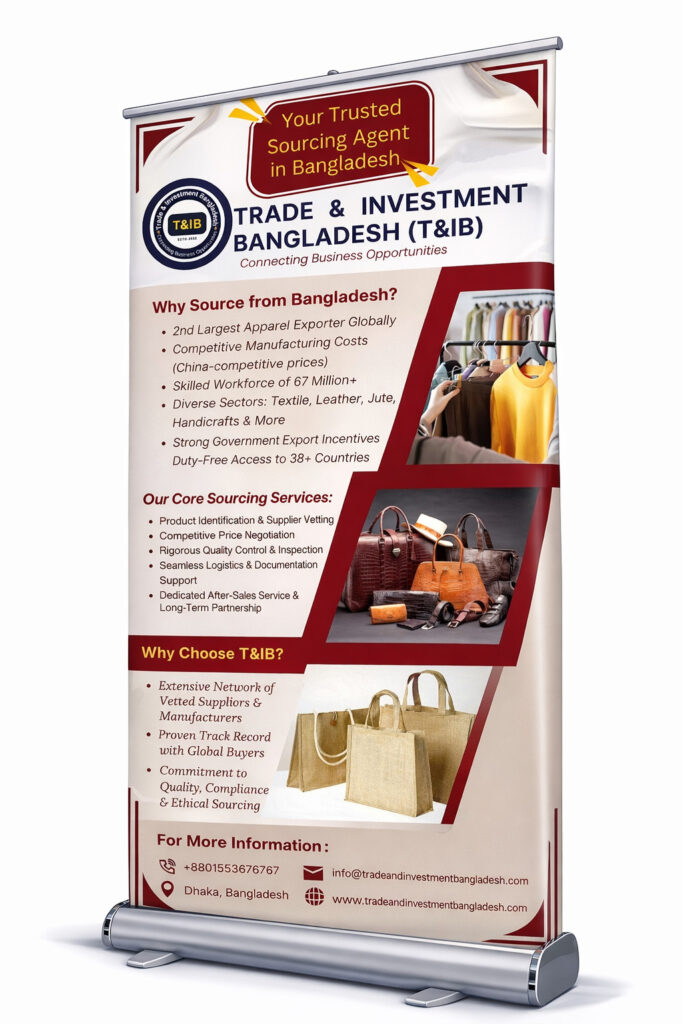
T&IB as a Sourcing Partner: Converting Bangladesh’s Supplier Market Into a Managed Supply Solution
Trade & Investment Bangladesh (T&IB) is positioned to act as a sourcing partner for international buyers who want Bangladesh’s production advantages without the typical on-the-ground complexity. Rather than treating sourcing as a one-time matchmaking activity, T&IB supports buyers through an end-to-end sourcing workflow that reduces uncertainty and increases execution reliability.
A professional sourcing partnership begins with translating the buyer’s requirement into a sourcing plan: product specifications, target price range, compliance needs, lead-time expectations, packaging standards, labeling rules, testing requirements, and shipment terms. Once requirements are clear, the next step is supplier shortlisting based on capability and fit because the “right supplier” is not necessarily the largest supplier, but the one that matches your product category, quality level, compliance profile, and delivery discipline.
From there, a buyer needs evidence, not promises. T&IB’s value is in organizing the practical steps that buyers need for confident decision-making: supplier verification and background checks, sample development coordination, price and MOQ negotiation support, factory communication management, and alignment of production milestones with inspection checkpoints. This approach is especially important for first-time buyers to Bangladesh, buyers expanding into new product lines, and buyers who need to consolidate procurement across multiple factories under one consistent management system.
T&IB also aligns with the broader trade facilitation role that buyers rely on locally: supporting communication, documentation readiness, shipment coordination, and resolution of operational issues before they become costly delays. In a market where supplier options are abundant, disciplined sourcing execution becomes the differentiator and that is precisely where a structured partner adds measurable value.
Contact Details of T&IB
For international buyers who want to source products from Bangladesh with a structured, professionally managed approach, you may contact Trade & Investment Bangladesh (T&IB) through the following official channels: Phone: +880 1553 676767 and +880 1992 677117; Email: info@tradeandinvestmentbangladesh.com; Location: Dhaka, Bangladesh.
Closing Remarks
Bangladesh offers international buyers a rare combination of manufacturing scale, export maturity, and expanding sustainability capacity backed by export performance that demonstrates resilience and global relevance. But buyers achieve the best outcomes when sourcing is treated as a managed process rather than a supplier hunt. The market is large, and supplier choices are many; the competitive edge comes from selecting verified partners, building repeatable quality systems, and coordinating production and shipment execution with discipline. By working with T&IB as a sourcing partner, international buyers can access Bangladesh’s manufacturing strengths through a single coordinated interface reducing risk, improving supplier alignment, and accelerating the path from inquiry to shipment. In a global marketplace where supply reliability is as important as price, Bangladesh can be your strategic sourcing base and T&IB can help you build that base with confidence.